

Projects in Japan
Top Story
Case Study: Advancing Half-Hourly Matching for EV Charging in Japan
This case study highlights a pioneering project in Japan that brings the concept of hourly matching into real-world application. Led by D-Sharing Co., Ltd. under a Ministry of the Environment program, the initiative demonstrates how distributed community solar can be matched with EV daytime charging on a half-hourly basis using granular certif
By integrating smart meter data, a P2P trading platform, and behavioral insights, the project enabled time-aligned transactions between local solar prosumers and EV users. It represents one of the first government-backed implementations of time-resolved matching in Japan, offering valuable insights into technical feasibility, economic scalability, and future policy design.
As interest in granular energy markets grows globally, this project provides a concrete example of how hourly matching can move from concept to system-level deployment.

NTT Group and JERA Cross Announce Japan’s First Biomass-Based Hourly Matching Demonstration
NTT Anode Energy, JERA Cross, and NTT Docomo on February 12, 2026 announced the completion of a demonstration project delivering 24/7 carbon-free electricity to three telecom facilities located in Aomori, Akita, and Sendai. Conducted from December 2024 through September 2025, the project represents Japan’s first case of hourly matching utilizing biomass generation.

Kansai Electric and BIPROGY Announce Launch of Hourly Matching Demonstration Using Corporate PPA
Kansai Electric Power and BIPROGY on December 18, 2025 announced the initiation of a demonstration project applying corporate PPA structures to align electricity supply and demand on an hourly basis.A

J-POWER and Mizuho Announce Successful Hourly Matching Demonstration for 24/7 Corporate PPA in Japan
J-POWER, Mizuho Bank, Mizuho Securities, Mizuho Leasing, and Scalar Inc. announced on April 17, 2026 that they had successfully demonstrated hourly supply-demand matching aimed at enabling 24/7 carbon-free energy procurement, as announced.

Tokyo Metro Introduces Hourly-Matching Physical PPA with Wind and Agrivoltaic Solar in Japan
Tokyo Metro, in collaboration with Cosmo Energy Group companies, has launched an off-site physical PPA supplying its training facility using a combination of onshore wind and agrivoltaic solar power. Electricity supply began in April 2026, with an estimated annual CO₂ reduction of approximately 719 tons.
Topics in Japan
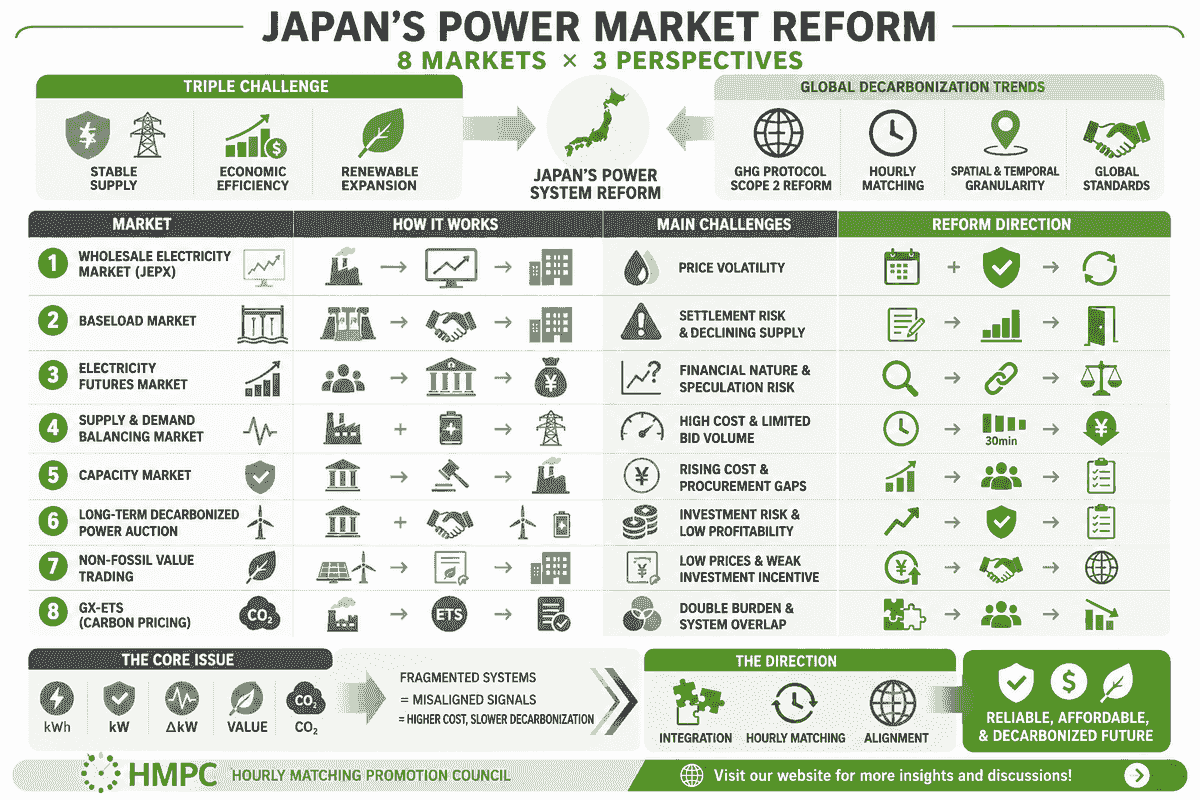
Power Sector Reform in Japan
Japan's power sector faces a daunting challenge of simultaneously ensuring a stable supply of electricity, improving economic efficiency, and further expanding renewable energy.Amid current inflation, high interest rates, and population decline, explosive growth in electricity demand driven by data centers, the shift to EVs, and the repatriation of production facilities may necessitate the largest expansion of power generation and grid infrastructure in 40 years.
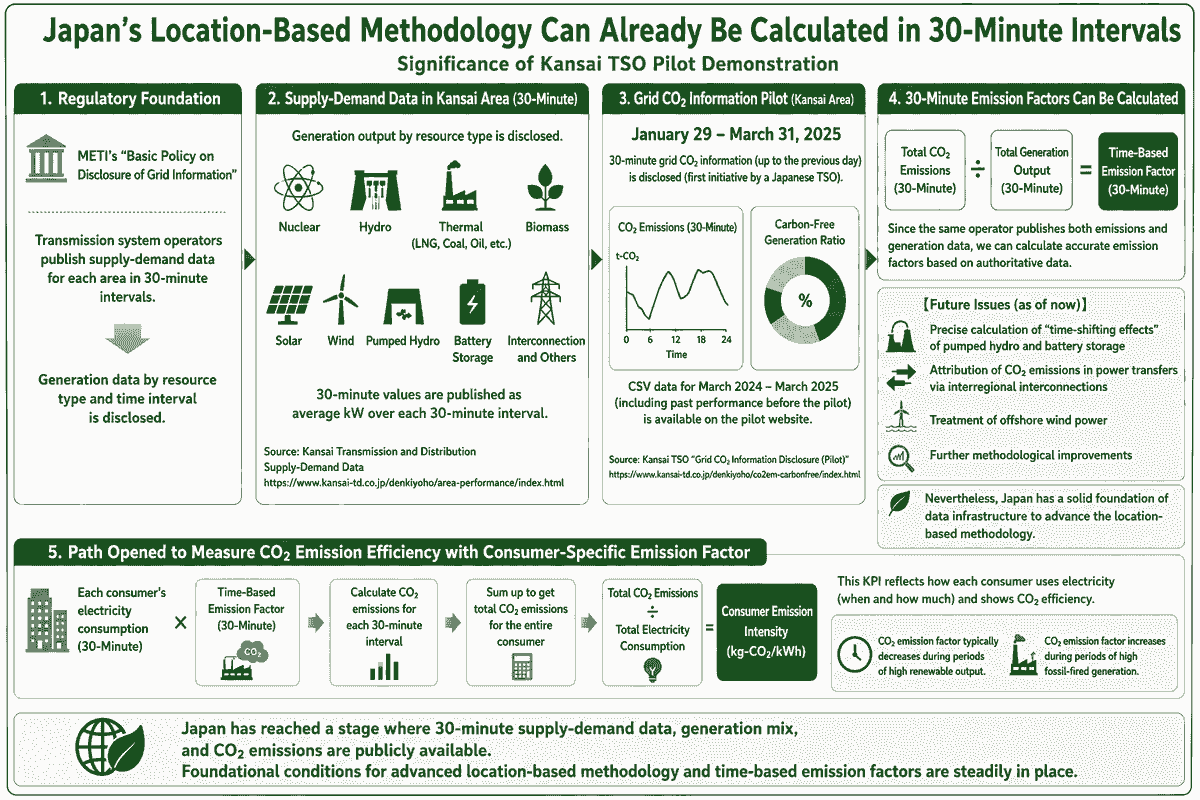
Japan May Already Have Foundations for 30-Minute Location-Based Emissions Accounting
As debate around GHG Protocol Scope 2 revision accelerates, hourly emissions accounting and temporal matching are moving from theory toward operational reality.
Japan may already possess much of underlying data infrastructure required for advanced location-based methodology.

Solar Power Grid Parity Challenges Identified: JPEA Releases Report on PPA Revenue Structures and Battery Integration Realities
The Japan Photovoltaic Energy Association (JPEA) published a research report on April 28, 2026, based on a fiscal year 2024 subsidy project survey conducted by Mitsubishi Research Institute. This report analyzes the current status and barriers for "Corporate PPA" and "Renewable Energy-Linked Storage Batteries," which are expected to play central roles in achieving carbon neutrality.

Google advances toward 24/7 carbon-free energy globally at 66%, but Japan remains at 17% — what should Japan do to raise its hourly matching rate?
Google has released its 2025 Environmental Report, outlining progress toward its ambition to match electricity consumption with carbon-free energy on an hourly basis across all operations. As of 2024, the company has achieved a global average of 66% carbon-free energy (CFE), with 9 out of 20 grid regions reaching at least 80% hourly matching. In the announcement, this effort is framed not merely as a procurement strategy, but as a pathway to reshaping power systems toward real decarbonization

Japanese Financial and Policy Leaders Call for Phased Scope 2 Reform — Practical Signals for Global Market Participants
As debate intensifies globally over the pace of introducing stricter temporal granularity in Scope 2, leading Japanese institutions have now set out clear, practice-oriented positions. Their submissions offer concrete signals for international experts assessing entry strategies into Japan’s evolving clean energy and carbon accounting landscape.
On December 26, 2025, the Japanese Bankers Association (JBA) submitted its formal response to the Scope 2 Guidance revision consultation. The document reflects a financial-sector perspective grounded in operational realities rather than theory, highlighting where implementation friction is most likely to emerge.


