

Innovative Solutions
For Emerging Economies
Advancing Regulatory Frameworks, Technical Readiness, and Market Structures
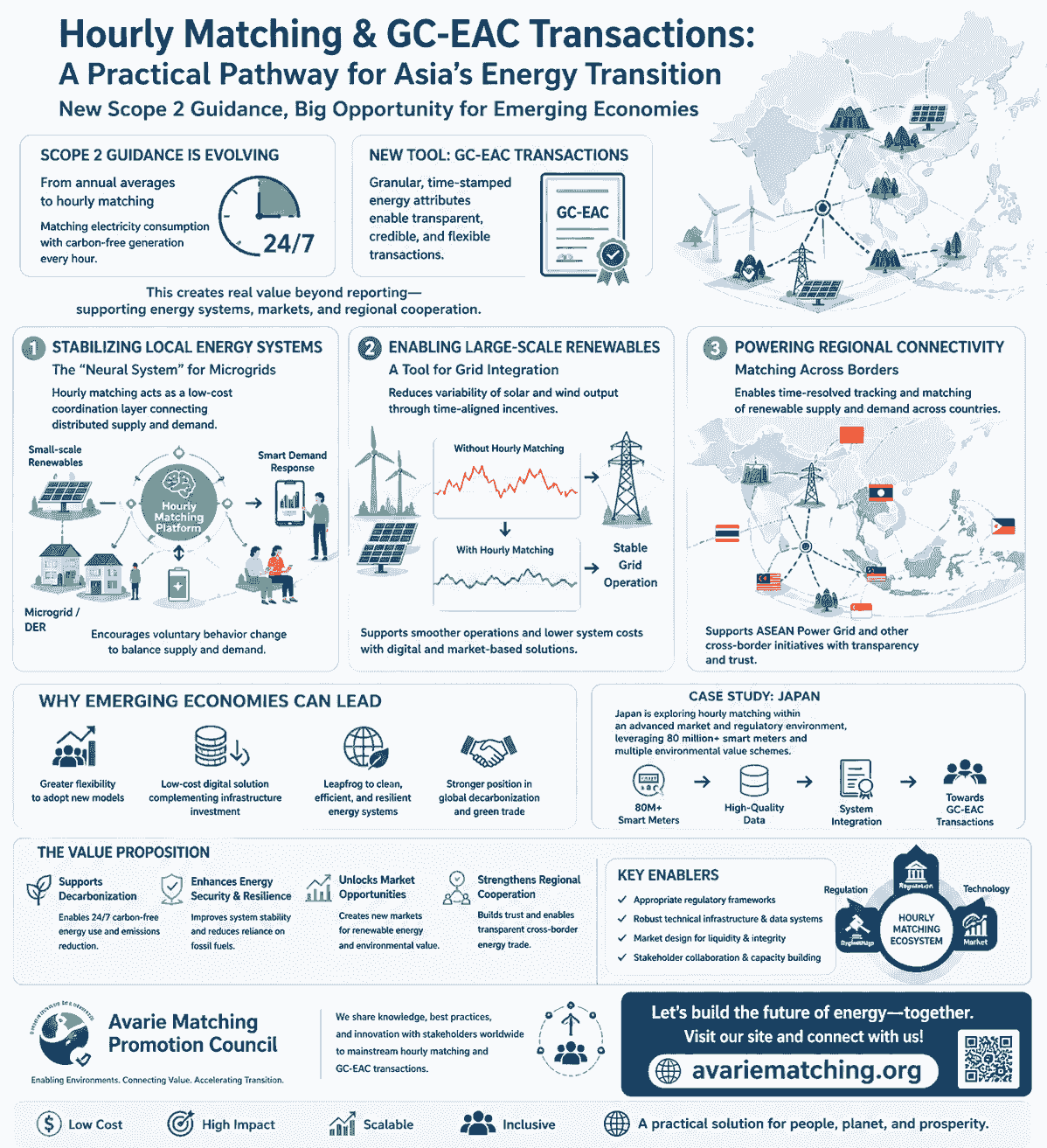
Hourly Matching & GC-EAC Trade as a Low-Cost Enabler for Energy Transition for Emerging Economies
The revision of the GHG Protocol Scope 2 guidance signals a shift from annual averages to time-based alignment, matching electricity consumption with carbon-free generation on an hourly basis.
This creates a new class of instruments, such as GC-EACs, which can move beyond accounting and serve as practical tools for shaping real-world energy systems—particularly in developing and emerging economies.

Korea Scales Floating Solar on Agricultural Reservoirs: A Community-Centric Model for Sustainable Energy Transition
Korea’s floating solar model shows how renewable energy can support both decarbonization and rural development. By using reservoirs as dual-use assets, it generates clean power while funding water infrastructure. Crucially, revenue is shared with local communities, improving acceptance and ensuring benefits stay local. For developing countries, this highlights how aligning technology, finance, and community participation can create scalable, inclusive, and sustainable energy systems.

Solar Carports from Spain: A Best Practice for Scaling Distributed Renewables in Emerging Economies
Spain—particularly Málaga—demonstrates how solar carports can function as integrated energy systems, combining solar generation, EV charging, and on-site consumption.
This model is highly replicable in emerging economies with strong solar resources, offering a low-cost, decentralized alternative to grid-intensive development.For development finance institutions, it provides a practical, scalable pathway to accelerate deployment and mobilize private capital.

Scaling Distributed Renewables for Sustainable Development - Actionable Insights for Development Finance
As emerging economies expand energy access while managing fiscal and energy security constraints, distributed renewable energy is becoming a strategic priority. Solutions such as plug-in solar and behind-the-meter systems offer scalable, low-capex pathways to accelerate deployment.
Advanced markets are already demonstrating innovative models that combine technology, financing, and policy design. For multilateral development banks and public financiers, these approaches provide replicable frameworks to de-risk projects and mobilize private capital.
This platform highlights practical, field-tested best practices—bridging global innovation with project implementation across developing regions.


